
Collectors Won’t Find Invisible Artists
Most artists believe they need more followers. They don't. They need to become discoverable. Learn how collectors actually find and buy original artwork through Google, Pinterest, websites, referrals and buyer psychology—and why visibility is often more important than talent alone.


How Artists Attract Collectors Online
Most artists believe they need more followers. They don’t. They need more collectors.
I spent decades believing that if I painted well enough, collectors would eventually find me.
Retirement gave me the opportunity to build my own artist website from the ground up. What began as a website project turned into months of researching how collectors actually discover and buy art online.
The more I researched, the more one uncomfortable truth became impossible to ignore.
Collectors don’t search the way artists think they do.
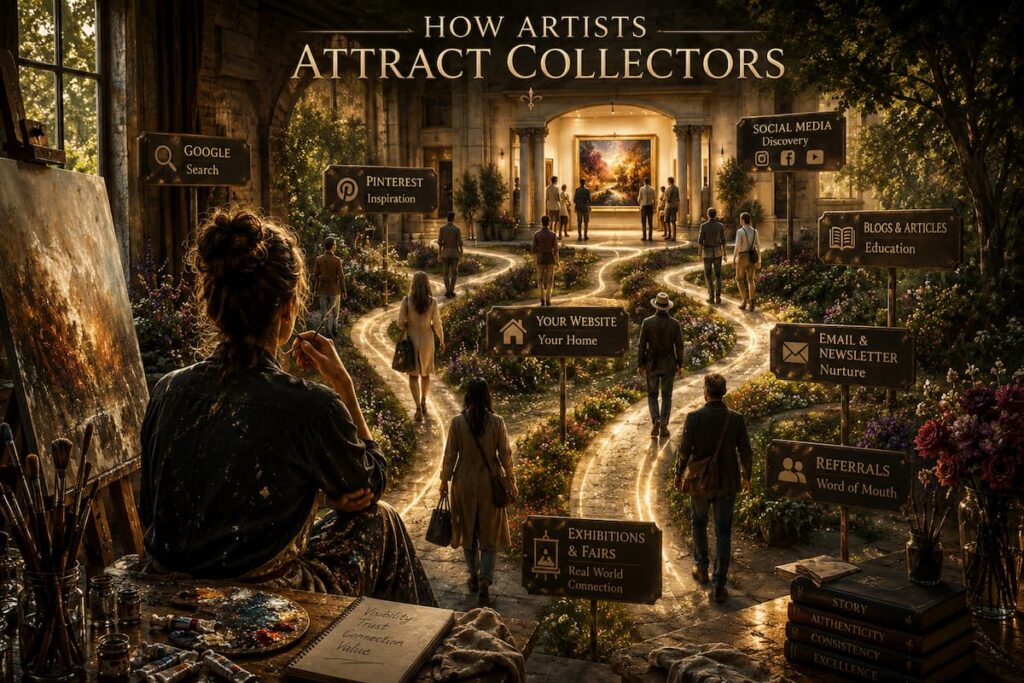
Table of Contents
Why Most Artists Market Their Work the Wrong Way
“Talent alone doesn’t sell art. Visibility does.”
For many years, I believed that creating better paintings would naturally lead to more sales.
It seemed logical.
Create exceptional work, exhibit it online and, sooner or later, collectors would discover it.
The more I researched how people actually buy art, the more I realised how wrong that assumption was.
While building my own artist website, I spent months studying how collectors discover, evaluate and purchase artwork online. What started as a website project soon became a much deeper exploration of buyer behaviour, search patterns, interior design trends and the digital journeys that lead people from curiosity to collecting.
One conclusion kept appearing, regardless of where I looked.
Collectors don’t think like artists.
In fact, they rarely begin by looking for an artist at all.
They’re searching for ideas to decorate a new home.
A statement piece for a lodge.
Artwork that complements a colour palette.
Something meaningful for a milestone birthday or anniversary.
Original artwork for a corporate reception area.
The painting becomes the answer to a question they were already asking.
That single insight changed the way I think about marketing art.
It changed the way I designed my website.
It changed the way I write.
It even changed the way I think about creating future collections.
If artists want to sell more work online, we first need to understand how collectors make decisions.
Not how artists hope they do.
How Collectors Discover Art Online
Imagine opening a boutique in a shopping centre.
Would you choose the quietest corner where nobody walks past?
Or would you position your shop beside Woolworths, Checkers or Dis-Chem, where thousands of shoppers already pass every day?
Successful retailers don’t create traffic.
They benefit from traffic that already exists.
The internet works exactly the same way.
Google already has visitors.
Pinterest already has visitors.
Instagram already has visitors.
Interior design websites already have visitors.
Online art marketplaces already have visitors.
Your website doesn’t need to create traffic from nothing.
It needs to become the destination those existing visitors eventually reach.
Your website is the gallery.
Everything else becomes another entrance leading collectors there.

A Difficult Truth
Many artists spend years trying to become better painters.
Far fewer spend the same amount of time understanding how collectors actually buy art.
Yet collectors don’t purchase paintings because of brushwork alone.
They buy confidence.
They buy stories.
They buy emotion.
They buy artwork that fits the life they’re creating.
Decorating trends influence demand.
Colour palettes influence demand.
Lifestyle changes influence demand.
Different generations buy art for different reasons.
The better you understand your audience, the easier it becomes to create meaningful connections between your work and the people most likely to collect it.
Being discoverable isn’t about being everywhere.
It’s about being visible in the right places, to the right people, at the right time.

Artists Think Like Artists Collectors Think Like Collectors
This was perhaps the biggest lesson from my research.
| Artists naturally think about: | Collectors usually don’t. Instead, they ask questions like: |
| Technique. | Will this painting suit my home? |
| Brushwork. | Does it work with my colour palette? |
| Composition. | Is it the right size? |
| Awards. | Can I trust this artist? |
| Exhibitions. | How will it be shipped? |
| Social media followers. | Can I commission something similar? |
| What happens if it arrives damaged? | |
| Why did the artist paint this? |
Notice something?
Very few of those questions are about paint.
They’re about confidence.
Collectors don’t simply buy artwork.
They buy certainty.
Your website should answer those questions before they’re even asked.
The Collector Journey
One of the biggest mistakes artists make is assuming that collectors search for art in the same way artists search for inspiration.
They don’t.
Collectors follow a journey.
It usually begins long before they know which artist they’ll eventually buy from.
They gather ideas.
Compare styles.
Explore interiors.
Save images.
Research colours.
Read articles.
Ask friends.
Build confidence.
Only then do they start comparing artists.
Understanding that journey changes everything.
Instead of asking:
“How do I get more people to visit my website?”
you begin asking:
“Where are collectors already spending their time, and how can I become part of that journey?”
That question became the foundation for everything that follows in this guide.

Why Great Art isn’t Enough
This may be the hardest truth for artists to accept.
A brilliant painting that nobody discovers has exactly the same commercial value as one hidden in a storeroom.
Visibility creates opportunity.
Opportunity creates trust.
Trust creates sales.
Today’s collectors discover artists through Google, Pinterest, blogs, recommendations, social media, interior designers, online galleries and AI-powered search.
The artists who thrive online aren’t necessarily creating more artwork.
They’re making it easier for people to discover the artwork they already create.

The Question Every Artist Should Ask
Before you spend another hour trying to gain more followers or posting another painting online, ask yourself one simple question:
If someone searched today for the type of artwork I create, how many opportunities would they have to discover me?
If the answer is one—or none—your next masterpiece isn’t another painting.
It’s becoming easier to find.
That is what this guide is about.
Together, we’ll explore ten practical strategies that help artists become visible where collectors already spend their time, build trust before the first conversation and create an online ecosystem that continues attracting buyers long after a social media post has disappeared from the feed.
Why Followers Don’t Automatically Become Collectors
One of the biggest misconceptions in the art world is that a large social media following automatically leads to more sales.
It doesn’t.
Followers and collectors are not the same people.
Many artists spend years building audiences made up largely of other artists. While those communities provide encouragement, inspiration and valuable feedback, they rarely represent the people most likely to purchase original artwork.
Collectors have different priorities.
Interior designers are searching for artwork that complements a client’s project.
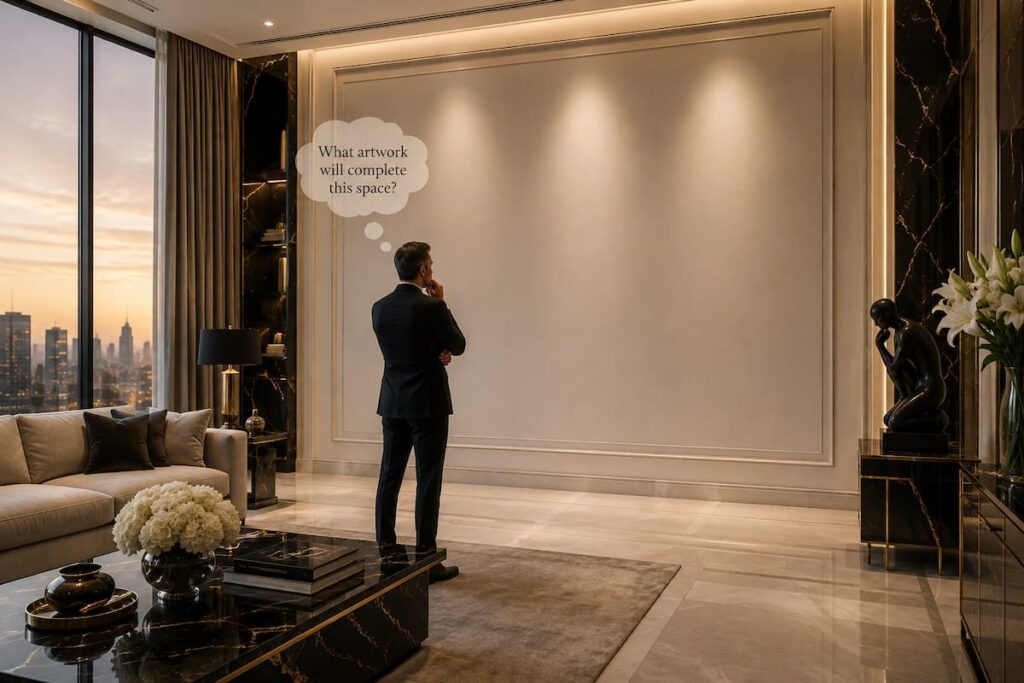
Homeowners are looking for a statement piece that completes a room.
Hospitality businesses need artwork that reflects the atmosphere they want to create.
Corporate buyers are investing in spaces that represent their brand.
These audiences are not searching for painting demonstrations or discussions about brush techniques. They’re looking for artwork that solves a problem, tells a story or transforms a space.
A smaller audience of the right people is often far more valuable than thousands of followers with no intention of buying.
Instead of asking,
“How do I get more followers?”
start asking,
“Am I visible to the people who actually collect the type of artwork I create?”
That single shift in thinking can completely change your marketing strategy.
Your goal isn’t to become popular.
Your goal is to become discoverable by the right audience.

Why Interior Design Trends Influence Art Sales
Many artists prefer to believe that great art exists independently of trends.
Artistically, that’s true.
Commercially, it’s more complicated.
Collectors rarely buy artwork in isolation.
They buy artwork for a space.
A newly renovated home.
A boutique hotel.
A corporate reception area.
A luxury lodge.
A holiday apartment.
The artwork becomes part of a much bigger design story.
That’s why interior design trends have such a significant influence on the art market.
When warm neutrals become fashionable, buyers naturally search for artwork that complements those colours.
When modern organic interiors become popular, collectors look for textures, earthy palettes and calming compositions.
When dark, dramatic interiors trend, artwork with richer colours and stronger contrast often attracts more attention.
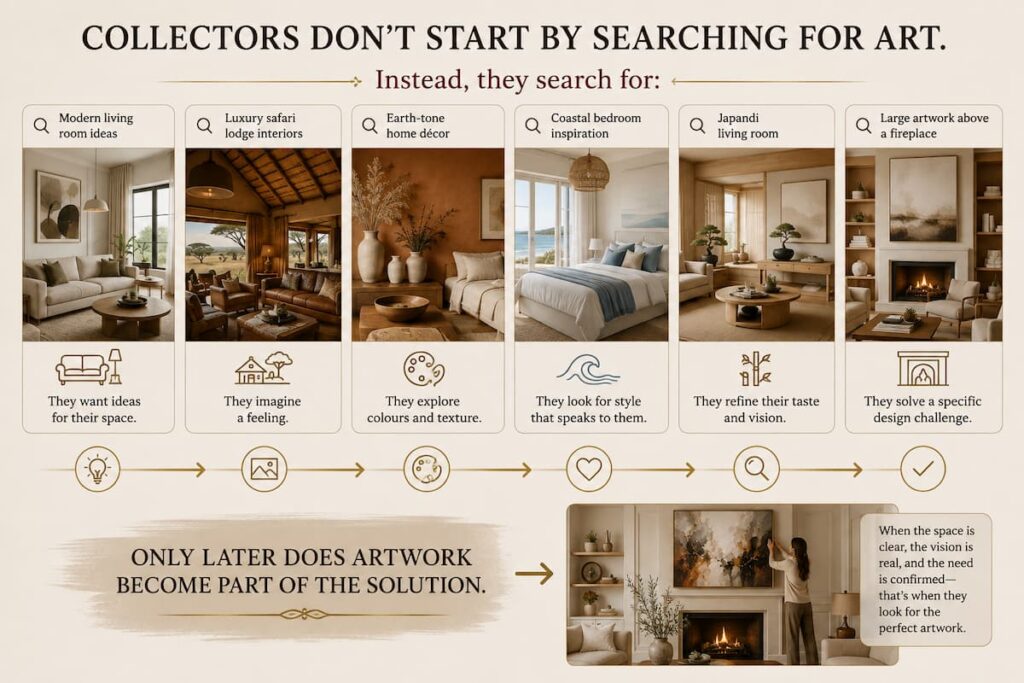
Most people don’t begin their search by typing:
“Original oil painting.”
Instead, they search for:
- Modern living room ideas
- Luxury safari lodge interiors
- Earth-tone home décor
- Coastal bedroom inspiration
- Japandi living room
- Large artwork above a fireplace
Only later does artwork become part of the solution.
This doesn’t mean artists should chase every passing trend or abandon their own style.
It means understanding the environment in which collectors discover art.
The most successful artists remain true to their artistic voice while presenting their work in ways that connect with contemporary lifestyles and the people they hope to reach.
Understanding your audience is just as important as understanding your medium.
When you know who your ideal collectors are, how they live, what inspires them and how they search for ideas, becoming discoverable becomes far easier.
The Ten Strategies That Make Artists Discoverable
- Understanding how collectors think is only the beginning.
- The next step is making it easy for them to find you.
- None of these strategies works particularly well on its own.
- Together, however, they create what I call an Anchor Network—an online ecosystem where every platform supports every other platform, and every path eventually leads collectors back to your website.
- Think of these strategies as building multiple entrances to the same gallery.
- The more entrances you create, the more opportunities collectors have to discover your work.
Build a Website You Own
Your website isn’t simply another place to display artwork.
It’s the one digital asset you completely control.
Social media platforms change.
Algorithms change.
Online marketplaces change.
Your website doesn’t.
It becomes your permanent gallery, your portfolio, your story, your shop and your business headquarters.
Everything else should lead people back to it.
Make Google Work for You
Google already has millions of people searching every day.
The question is whether your artwork appears when they’re looking.
Collectors rarely search for an artist’s name.
They search for subjects, colours, styles and ideas.
Original wildlife paintings.
Large abstract landscapes.
Contemporary South African art.
Luxury lodge interiors.
Every artwork page and every blog article becomes another opportunity for Google to introduce your work to someone who has never heard of you before.
Treat Pinterest as a Search Engine
Pinterest isn’t about followers.
It’s about discovery.
People use Pinterest to plan future purchases, decorate homes and collect ideas.
Many save Pins for weeks or even months before making a buying decision.
Every Pin should link directly back to your website.
Instead of thinking,
“I’m posting on Pinterest,”
think,
“I’m creating another doorway into my gallery.”
Share Stories, Not Just Paintings
Collectors don’t simply buy artwork.
They buy connection.
Share the moments that never appear in the finished painting.
The sketchbook.
The colour decisions.
The failed attempts.
The inspiration.
The framing.
The packaging.
The delivery.
Stories build trust.
Paintings start conversations.
Together, they create collectors.
Answer the Questions Collectors Are Already Asking
Most artists only publish artwork.
Very few publish knowledge.
That’s your opportunity.
Every helpful article becomes another entrance into your website.
Teach people:
- how to choose artwork
- how commissions work
- how paintings are shipped
- how to care for original art
- how to select the right size
When you answer real questions, Google begins introducing your website to people searching for those answers.
Build Relationships, Not Audiences
Email remains one of the few channels you truly own.
Unlike social media, nobody decides whether subscribers see your message.
Every subscriber has already expressed genuine interest.
Those are often your future collectors.
Stay in touch.
Share stories.
Share new collections.
Share progress.
Relationships grow slowly.
So do collector confidence and trust.
Become Easy for Interior Designers to Recommend
Interior designers don’t simply need beautiful artwork.
They need reliable information.
Provide:
- dimensions
- room mock-ups
- framing options
- professional photography c
- olour information
- commission availability
The easier you make their job, the more likely they are to recommend your work repeatedly.
Expand Your Gallery Beyond Your Website
Your website should always remain your primary gallery.
But it shouldn’t be your only entrance.
Selected art marketplaces, design platforms and professional directories introduce your work to collectors who may never have found you otherwise.
Think of them as additional roads leading to the same destination.
Let Your Collectors Tell Your Story
Nothing builds confidence faster than another collector saying,
“Buying from this artist was a wonderful experience.”
Share testimonials.
Photograph artwork in collectors’ homes.
Celebrate installations.
Encourage referrals.
Trust spreads through people.
Build an Anchor Network
This is where everything comes together.
Your Instagram should lead to your website.
Pinterest should lead to your collections.
Your blog should answer questions and link to relevant artwork.
Collection pages should link to commissions.
Commission pages should link to your portfolio.
Testimonials should reinforce trust.
Nothing should exist in isolation.
Each piece strengthens every other piece.
Instead of relying on one platform, you build an interconnected ecosystem that keeps working even when algorithms change.
Why Artist Websites Lose Collectors
Artists often assume that if someone reaches their website, the difficult part is over.
In reality, that’s where the decision-making process begins.
Every visitor arrives with questions.
Can I trust this artist?
Is this artwork original?
Will it suit my home?
How big is it?
How much does shipping cost?
Can I commission something similar?
What happens if it arrives damaged?
If your website doesn’t answer those questions quickly and clearly, many visitors will simply leave.
Not because they dislike your artwork.
Because uncertainty creates hesitation.
The most successful artist websites don’t overwhelm visitors with information.
They remove uncertainty, one question at a time.
Common mistakes include:
- Slow-loading pages.
- Confusing navigation.
- Poor-quality photography.
- Artwork without dimensions.
- No room visualisations.
- Hidden pricing or no pricing guidance.
- Difficult enquiry forms.
- No artist story.
- No explanation of shipping or returns.
- No clear next step.
Every unnecessary click creates friction.
Every unanswered question reduces confidence.
Think of your website as a conversation with a collector.
If they constantly have to stop and ask, “Where do I find that information?”, you’ve already made buying harder than it needs to be.
The best artist websites feel effortless.
Visitors always know where they are, what to do next and how to move forward.
That’s not good web design.
That’s good customer experience.
Your First 90 Days
Becoming discoverable doesn’t happen overnight.
It isn’t the result of one viral post or a single successful exhibition.
It’s the result of building an online ecosystem that becomes stronger over time.
Rather than trying to do everything at once, focus on steady progress.
Month One — Build the Foundation
Your website is the centre of everything.
Make sure it clearly explains:
- who you are
- what you create
- who your artwork is for
- why it matters
- how collectors can buy or commission your work
Then publish two helpful articles that answer questions your ideal collectors are already asking.
Think like a collector, not an artist.
Month Two — Increase Your Discoverability
Now begin creating more entrances to your website.
Optimise your artwork pages for search.
Create Pinterest boards that link back to your collections.
Share stories instead of simply posting finished paintings.
Encourage visitors to join your email list.
Every article, Pin and social media post should guide people back to your website.
Month Three — Build Trust
This is where discoverability becomes credibility.
Ask collectors if you can photograph your artwork in their homes.
Collect testimonials.
Build relationships with interior designers.
Review your website analytics.
Which pages are attracting visitors?
Which articles keep people reading?
Which artworks receive the most attention?
Your audience is constantly telling you what interests them.
Listen carefully.
Discoverability Is an Ongoing Process
One of the biggest misconceptions about marketing is that it’s something you finish.
It isn’t.
Every article you publish.
Every Pinterest Pin you create.
Every collection you add.
Every testimonial you share.
Every improvement you make to your website.
Every relationship you build.
Strengthens your online presence.
Over time, these individual pieces become an interconnected network that continues working long after you’ve finished creating them.
That’s how discoverability grows.
Final Thoughts
Shopping centres don’t succeed because every shop creates its own traffic.
They succeed because they place businesses where customers are already going.
Artists can do exactly the same.
Stop hoping collectors will somehow discover your website.
Stop measuring success by the number of followers you have.
Stop trying to be visible everywhere.
Instead, understand your ideal collector.
Learn how they search.
Understand what they need before they know they need your artwork.
Build a website that answers their questions.
Create content that helps them.
Position your work where they already spend their time.
Most importantly, connect everything together.
Your website.
Your blog.
Pinterest.
Instagram.
Google.
Email.
Recommendations.
Each one becomes another entrance leading collectors back to your gallery.
Because in today’s digital world, the artists who succeed aren’t always the ones creating the most artwork.
They’re the ones who make it easiest for the right people to discover the artwork they already create.
References
Google Search Central – SEO Starter Guide
Google Search Central – Documentation
Nakada Design – Architecture Firm Website Design
Nakada Design – Luxury Marketing Agency